


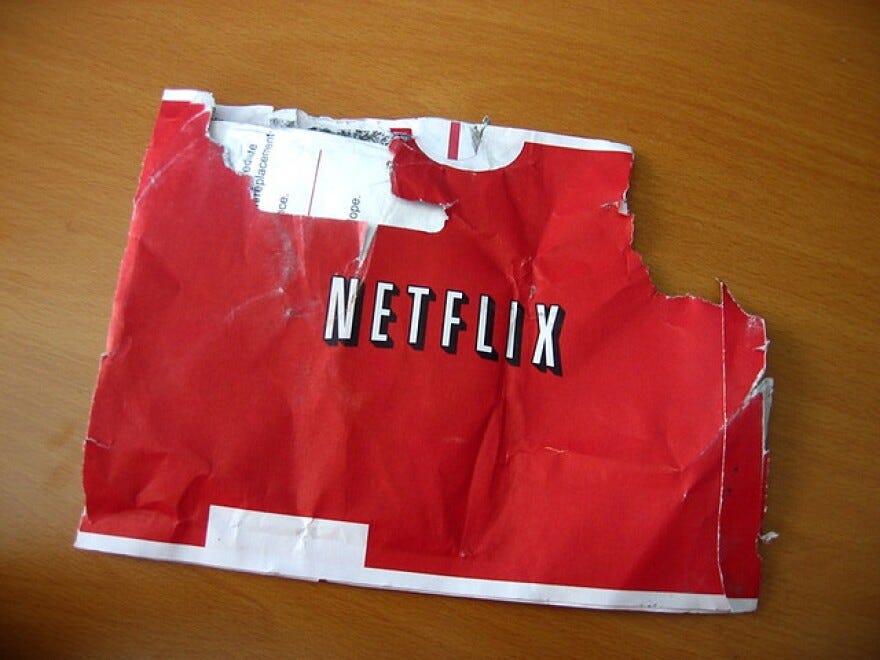
In 1998, Netflix was mailing out plastic discs in little red envelopes. In 2025, Netflix is merging with Warner Bros Discovery, taking control of a century of studio history, HBO, and some of the most valuable IP on the planet.
A lot of people want to tell this story as “Netflix killed theaters.” I do not think that is true.
What actually happened is more complicated, and more interesting. Netflix did not single-handedly destroy theatrical.
I have a strange, almost accidental relationship to this moment in Hollywood.
From late 2021 to early 2023, I worked at Warner Bros in Physical Production and Creative Development, right at the tail end of the AT&T era and then through the early days of the Warner Bros–Discovery merger. I watched, from the inside, a legacy studio trying to redefine itself in real time. It was a place full of talented people, but it was also a place feeling the full weight of a fractured industry. Every strategic conversation seemed tied to an identity crisis. What is a studio supposed to be in a streaming-first world And what exactly was Warner Bros becoming
Then in early 2023, I moved to the Netflix Film Team, where I worked until mid 2024. The contrast was immediate. Netflix felt like a company that already understood its future. It was tech forward, global minded, and run with a clarity of purpose that the legacy studios simply didn’t have. The company was evolving and dominating in a way that felt inevitable. But there was also one thing that was unmistakably clear while I was there. Netflix did not see theatrical movies as a priority. They used theatrical selectively, strategically, or for awards season, but it was never the core business.
Which is why the Netflix–Warner Bros merger hits so differently for me. I worked at both places. I saw their cultures. I saw their decision making. And now one is swallowing the other.
So before we get to where this is going, we have to revisit how we got here. Because Netflix did not kill theaters. Netflix did not kill Blockbuster. Netflix did not “break” Hollywood. The industry was already bending. Netflix was a catalyst, not the cause.
And to understand the world we’re stepping into, we have to go back to the beginning, when all Netflix had was a website and a stack of DVDs.
1. From DVDs In The Mail To Streaming Online (1997–2007)
Netflix began as a DVD-by-mail rental service in the late 1990s. Reed Hastings and Marc Randolph founded the company in 1997, and by April 1998 Netflix shipped its first DVD to a customer. Unlike video stores, Netflix’s mail service offered no due dates and no late fees, which was a radical shift at the time. The convenience and customer friendly design worked, and Netflix gained over 200,000 subscribers in its first year.
Even then, Netflix thought of itself as a technology company, not just a mail order Blockbuster clone. While the red envelope business was growing, the company was already investing in online streaming.
In January 2007, a decade after its founding, Netflix launched “Watch Now,” its first video streaming feature, offered as a free add-on for existing DVD subscribers. That moment quietly started the transition from DVDs to internet distribution long before most of Hollywood understood how disruptive streaming would be.
2. Blockbuster’s Missed Chance And Self Inflicted Decline
During Netflix’s rise, Blockbuster Video was still the dominant home entertainment brand, with thousands of stores in its blue and yellow colors. On paper, they should have crushed Netflix. In reality, Blockbuster’s decline was mostly self inflicted.
Blockbuster’s model depended heavily on late fees, earning around 800 million dollars in late fee revenue in the year 2000. Customers hated it. When Netflix introduced a subscription model with no late fees, it directly attacked Blockbuster’s biggest weakness.
Blockbuster also failed to embrace DVD-by-mail early enough. By the time they tried to copy Netflix, the cultural and technological momentum had already shifted.
There is also the infamous what-if. In 2000, Netflix’s founders offered to sell the company to Blockbuster for 50 million dollars. Blockbuster’s CEO passed on the deal. If Blockbuster had been willing to acquire Netflix and combine its nationwide brick and mortar footprint with a mail subscription product, we might be opening a Blockbuster app right now instead of a Netflix one.
Instead, Blockbuster carried debt, clung to late fees, and doubled down on a shrinking physical retail model. It peaked at around 9,000 stores in 2004, filed for bankruptcy in 2010, and closed its last corporate locations in 2014.
As one retrospective put it, if Blockbuster had not effectively turned the gun on itself, it might have been Netflix that died instead. The point here is important. Netflix did not simply “kill” Blockbuster. Blockbuster refused to evolve.
3. “Netflix And Chill” And The Era Of Licensed Streaming
After 2007, Netflix started aggressively licensing film and TV libraries from studios and networks. In the late 2000s and early 2010s, Netflix was the place where you could find a huge mix of catalog movies and past seasons of TV. It became the default streaming hub.
Culturally, the phrase “Netflix and chill” entered the lexicon as shorthand for staying in, streaming something, and probably hooking up. It was a joke, but it signaled something real. Netflix had become a habit. Press a button, scroll through endless tiles, and let the algorithm decide your night.
This version of Netflix was mostly a distributor. The majority of what people were watching were movies and shows made by other studios.
4. Hulu, The “What Could Have Been” Competitor
At the same time, the traditional TV networks tried to build their own answer. Hulu launched in 2007 as a joint venture between NBC and Fox, with Disney joining later. Hulu’s main advantage was next day streaming for network shows. In other words, they owned much of the exact content Netflix was bidding to license.
On paper, Hulu could have been the perfect Netflix competitor. The biggest TV players had the rights and the pipeline. What they did not have was full alignment. Hulu never became the unified streaming priority for all of its owners. It was treated more like a side project.
Netflix, on the other hand, had one job and one brand. That focus let it grow mostly unchallenged in the early streaming era.
5. Netflix Originals: From Middleman To Studio
The real turning point came when Netflix decided to stop just renting other people’s shows and start making its own.
Netflix’s first real step into originals was “Lilyhammer” in 2012. But 2013 is the year that really matters. That is when Netflix dropped “House of Cards” and “Orange Is the New Black.” Both shows were critical hits, awards contenders, and fan obsessions. They proved that a streaming service could play in the same prestige TV lane as HBO.
Binge watching became a design choice, not an accident. Entire seasons landed at once, and audiences devoured them.
Netflix followed up with shows like “Narcos”, “Daredevil”, and “Stranger Things”, which grew into a global phenomenon. In 2015, Netflix released “Beasts of No Nation,” its first original feature film. By 2017, it had passed 100 million subscribers worldwide and was earning serious awards recognition.
At this point, Netflix was no longer simply a platform. It was a studio and a hit maker. That changed how every other studio looked at it.
6. The Streaming Wars: Everyone Wants To Be Netflix
Traditional media companies watched Netflix transform from a customer into a rival. They drew one conclusion. If we keep licensing our content to Netflix, we are training people to love their brand, not ours.
The response was to build their own Netflix.
Between roughly 2018 and 2020, every major conglomerate launched a streaming service:
Disney launched Disney+, reclaiming Marvel, Pixar, Star Wars, and the Disney library.
WarnerMedia launched HBO Max, then rebranded the HBO streaming strategy around that app.
NBCUniversal launched Peacock.
ViacomCBS leaned into Paramount+.
Amazon expanded Prime Video and later acquired MGM.
The logic was simple. If distribution was shifting to subscription, you did not want to rent out your most valuable IP to someone else. You wanted to own the storefront.
Hulu, again, sat in an odd position. It could have been the single unified legacy competitor but ultimately became majority controlled by Disney and more of a domestic, niche offering.
Even with all of that, Netflix kept the lead. By 2025, it still had more subscribers than any other single streaming service, over 300 million worldwide.
7. Theaters In The Crossfire: Shrinking Windows And Vanishing Mid Budget Movies
While studios were scrambling to build streaming platforms, theatrical was quietly losing leverage.
This started before COVID. Ticket prices rose. Home screens got bigger and better. Audiences began asking a very simple question. Why should I leave the house for this?
Studios answered by heavily favoring IP driven event movies in theaters. Marvel, DC, major sequels, known brands. The mid budget adult drama or star driven original comedy that once thrived in theaters became a hard sell.
Martin Scorsese wrote about this in 2019, pointing out that in many markets franchise films had become the primary theatrical option, and mid range films were pushed to the margins. Those projects started going to streaming instead.
At the same time, the theatrical window shrank. The old standard of roughly 90 exclusive days gave way to 45 days or less. COVID then accelerated everything. Warner Bros put its entire 2021 slate day and date on HBO Max. Disney experimented with direct to Disney+ premieres and premium video on demand.
Audience behavior adjusted quickly. If you know a movie will be at home in four to six weeks, you do not rush out unless it feels like a communal event.
The result is a split market:
Big IP driven “must see in theaters” titles
Small indies that survive on critical buzz, awards, or niche audiences
The middle has mostly been hollowed out for theatrical and now lives primarily on streaming.
And again, this is where nuance matters. Netflix was a catalyst, but not the sole cause. Traditional studios made specific choices to prioritize franchises, shorten windows, and chase subscription revenue. Netflix simply showed them that a subscription world was possible.
8. Post COVID: Theaters As Events, Not Defaults
By the mid 2020s, theaters settled into a new role.
They did not die. They changed.
The big screen is now primarily reserved for:
IP event films
Premium formats like IMAX, 4DX, Laser projection
Revival and specialty programming
Unique, one off experiences
A good example is “The Wizard of Oz” at the Las Vegas Sphere. An almost century old film was reimagined as an immersive audio visual event. It has been earning up to 2 million dollars a day and is projected to cross 1 billion dollars in ticket sales over its run.
On the other side, we are seeing streaming hits move into theaters. Netflix’s animated musical “KPop Demon Hunters” is one recent example. It became the platform’s most watched film ever with more than 400 million views, then went into theaters as a special sing along release and made nearly 20 million dollars in a limited run.
That reverse window, streaming first and theatrical later, would have sounded insane fifteen years ago. Now it is a test case. If the audience is large enough online, the theatrical release looks less like a gamble and more like a monetization strategy.
All of this suggests that theatrical is becoming a premium layer on top of a project’s digital life, not always the starting point.
9. The Netflix – Warner Bros Merger
That brings us to the present.
In 2025, Netflix announced it would merge with Warner Bros Discovery in a deal valued at roughly 72 to 83 billion dollars. The company that once rented discs by mail is now absorbing one of the oldest and most important studios in Hollywood.
This merger folds into Netflix:
Warner Bros Pictures
HBO and HBO’s prestige library
DC Comics films and shows
Harry Potter
Lord of the Rings rights controlled by Warner
Looney Tunes and classic animation
A huge catalog of mid and high budget studio films
For years, Netflix’s relative weakness compared to Disney was library IP and legacy brand equity. With Warner absorbed, that gap shrinks. Netflix becomes both platform and old school studio. It owns tech, distribution, and a deep vault of franchises.
For theaters, this opens an interesting question. Warner understands theatrical. Netflix has always been more cautious on full theatrical runs for its originals. Combined, they now have every incentive to think in hybrid terms. Some projects will still be streaming first. Others will need traditional theatrical debuts to maximize franchise value.
In other words, Netflix is no longer just the company that disrupted Hollywood. It is one of the companies that now has to manage Hollywood.
10. The New Playbook: Hybrid Distribution And Audience First Thinking
So what does all this actually mean for filmmakers and for the future of movies
It means the old hierarchy is gone. There is no single “correct” window anymore. The playbook is hybrid, and it looks something like this:
Event theatrical runs for films that benefit from a big shared screen
Streaming premieres for projects where algorithmic discovery is more powerful than opening weekend
Shorter theatrical windows, often around 45 days, before a film hits streaming or premium rental
FAST channels (free ad supported channels) as a second or third life, the new cable
PVOD and digital rentals to capture at home dollars within weeks of release
Physical media and merch for super fans and collectors
Licensing to independent theaters, airlines, and international platforms for long tail revenue
The core idea is simple. A movie should not live in only one place. It should travel. It might debut in a theater, then move to streaming, then to a FAST channel. It might start on streaming, then tour across independent cinemas or a specialty venue if the audience proves it deserves a big screen moment.
All of that becomes easier when you already have a digital audience.
Conclusion: Building Audiences In A Netflix Plus Warner World
If there is one throughline from the red envelope era to the Netflix–Warner Bros merger, it is this. The companies that win are the ones that know how to build and hold an audience.
Blockbuster did not lose because Netflix existed. Blockbuster lost because it made itself hard to love and refused to evolve. Netflix won because it kept evolving, from DVDs, to licensed streaming, to originals, and now to owning one of Hollywood’s great studio libraries.
The theater did not disappear because streaming arrived. The theater’s role changed. It shifted from the default place you see every movie to the special place you go for certain movies.
Going forward, if you are a studio or a streamer or an independent filmmaker, the job is not to worship one format. The job is to understand how all of these formats work together.
You build the relationship with the audience online. You use streaming, social media, and digital platforms to make people care. Then when you ask them to leave the house, to buy a ticket, to attend a tour stop, or to show up for a one night only screening, you are not starting from zero. You are cashing in on trust that already exists.
In that sense, the Netflix–Warner Bros merger is not just a business headline. It is a sign of where power lives now. Power lives with whoever controls the relationship between stories and audiences, whether that interaction happens on a phone, on a couch, or in a seat under a very large screen.
And if you are trying to make films in this moment, the question to ask is not “Will theaters survive” or “Is streaming better.” The question is, “How am I going to build an audience strong enough that they will follow my work across every screen it touches”
In reading this I couldn’t help but think back to my own experiences as a moviegoer throughout my teens and into adulthood. I realized that throughout my teens as I experienced the decline of movie theaters, it went hand in hand with the decline of shopping malls and the rise of seat selection at movie theaters. I think those two combined had a huge effect on how audiences approached going to the movies. I used to show up to the mall with friends and family to watch movies as a teen, but that became increasingly less appealing as we lost the physical hang out space of malls and the ability to get to the theater early to get the best seats. It’s frustrating as a filmmaker to realize that Hollywood and theaters themselves brought about their own decline. Not to mention that with the rise of so many new streamers it’s often difficult to find a movie you are actively seeking out, I have to search just watch.com every time I want to find a specific movie. And nowadays trailers never mention a realest date! I cannot tell you the number of indie movies I’ve been actively excited to see and been disappointed to find out had come out two weeks ago and already not in theaters, with no clue as to where it might show up online at some point. It’s too much work being a movie fan nowadays 😞
Good points, great summarization. If I hate Netflix now as much as I hated Blockbuster’s late fees then, what does that point to? Anything?